
CI chain & review gate
The pre-ship CI gate that blocks bad deploys.
Note
CI chain & review gate is part of Creytix Inspector — QA and production readiness, detect and report, not auto-fix.
Overview
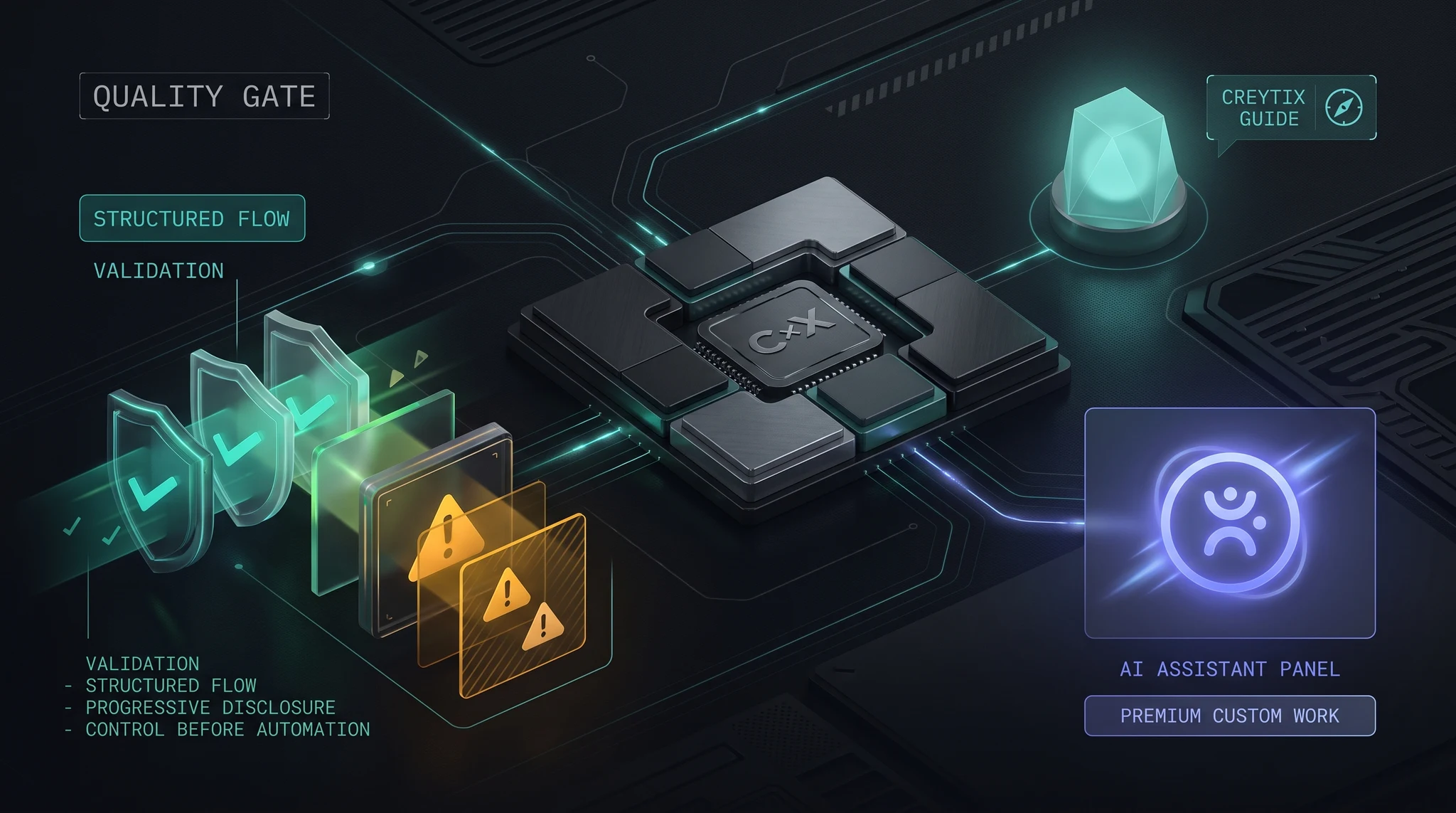
The CI gate is where Inspector's checks stop being advisory and start being enforced. It sits in front of a deploy: if Protect's rule checks — or any Playwright smoke checks layered on top — come back failing, the gate blocks the release instead of relying on someone remembering to look at a report before clicking deploy.
How it works
- Checks run as part of your release flow — Protect's rule checks, and any Playwright smoke checks you've wired in.
- Results roll up into a single gate decision — pass or blocked.
- A blocked release stays blocked until the failing checks are addressed or explicitly overridden by someone with the authority to do so.
Steps
- •
Wire Protect and smoke checks into your release flow
Connect the checks you want enforced — rule checks at minimum, browser smoke checks where you have them.
- •
Let a release attempt run the gate
Every release attempt runs the wired checks automatically, not on request.
- •
Read the gate result
A clear pass or blocked result, tied to which specific checks failed.
- •
Fix and re-run, or override deliberately
Address the failure and re-run, or make an explicit, logged decision to override.
Capabilities
- Pre-ship enforcement — turns Protect's rule checks into a hard gate, not just a report.
- Aggregated gate decision — one clear pass/blocked signal from multiple underlying checks.
- Deliberate overrides — a blocked release can be overridden, but it's an explicit, visible decision, not a silent skip.
Limits & honest scope
The CI gate enforces what you've wired into it — it doesn't invent checks on its own.
- It's only as strong as the checks feeding it. A gate with nothing wired in blocks nothing.
- It blocks releases; it does not fix the underlying issue or roll back a release already out the door.
- Override paths exist deliberately — the gate is a checkpoint, not a lock with no key.